Introducing OpenOCR Stratify
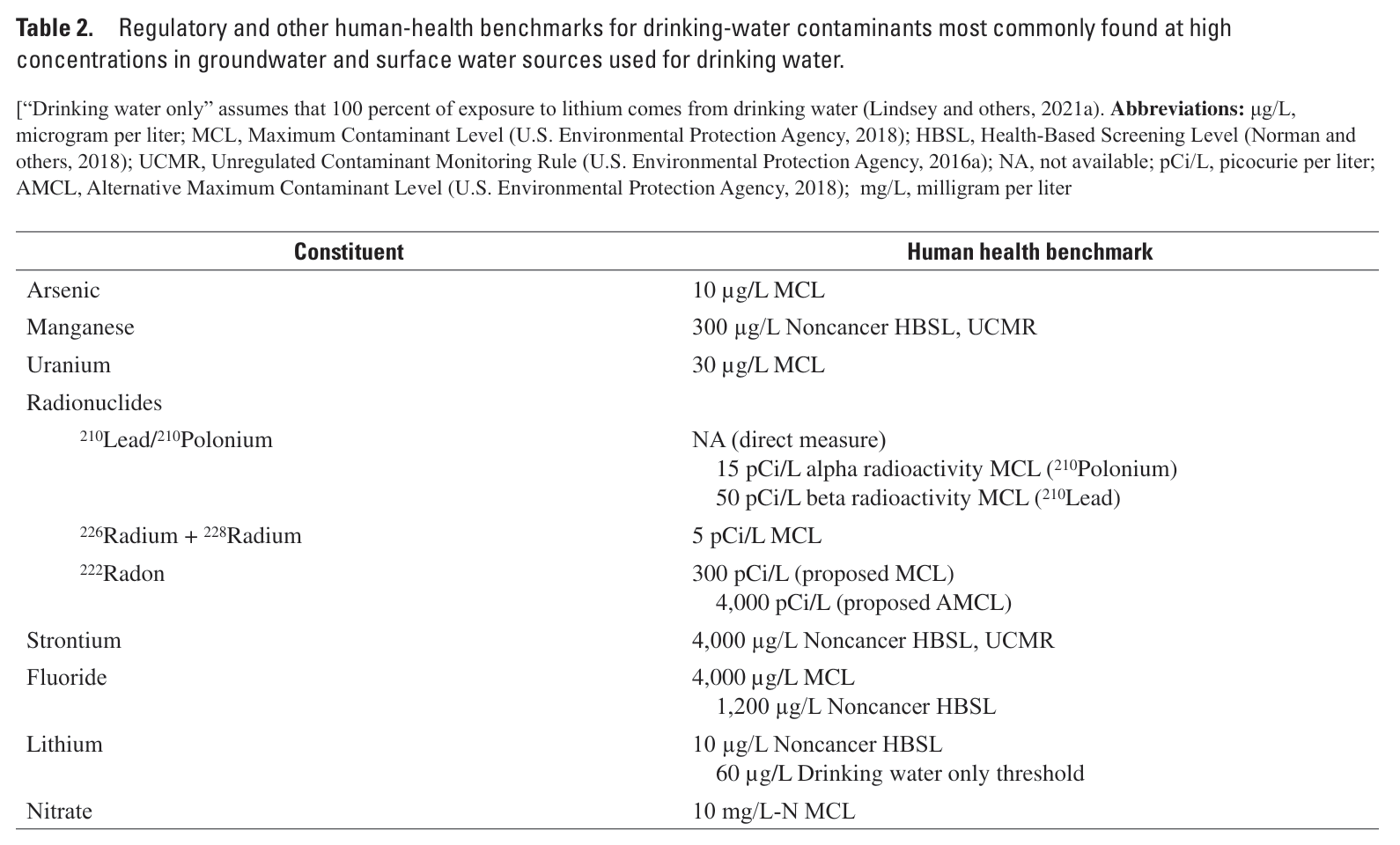
We’re designing Stratify to break complex documents into readable parts, choose the right tools for each part, and keep every result connected to its source.
A complicated document asks more of an OCR engine than recognizing words. It may need to follow two columns, reconstruct a table, read a handwritten correction, and keep a caption beside the figure it explains. Those jobs can appear on the same page, and the best way to read one part may differ from the next.
We are designing OpenOCR Stratify to handle that work in parts. Stratify would find the regions in a document, send them to the customer’s selected readers, and bring the results back together with their source references intact. A difficult table could get another pass without making the whole document start again.
The name reflects the approach: separate a complex document into parts that can be handled individually, while keeping track of how they fit together. The workflow has four parts: find the regions, choose the readers, extract the content, and reassemble the document.
OpenOCR already lets customers choose an OCR engine through a common API. Stratify would extend that choice to individual regions. The shared processing layer, API option, and workbench controls are in design and planning; they are not available today.
Why document structure matters
The page below comes from the USGS report Status of Water-Quality Conditions in the United States, 2010–20. It has two text columns, a section heading, and a table with a caption and abbreviation notes. The document is real: every image here is rendered from the published PDF. We have drawn the region boundaries manually to explain the proposed workflow.
Read across both columns as though they were one paragraph and unrelated sentences become neighbors. Detach the table from its notes and abbreviations lose their definitions. Flatten its indented rows and a relationship between a category and its entries can disappear. A list of correctly recognized words does not preserve these distinctions. Select the highlighted regions below to inspect the original pixels.
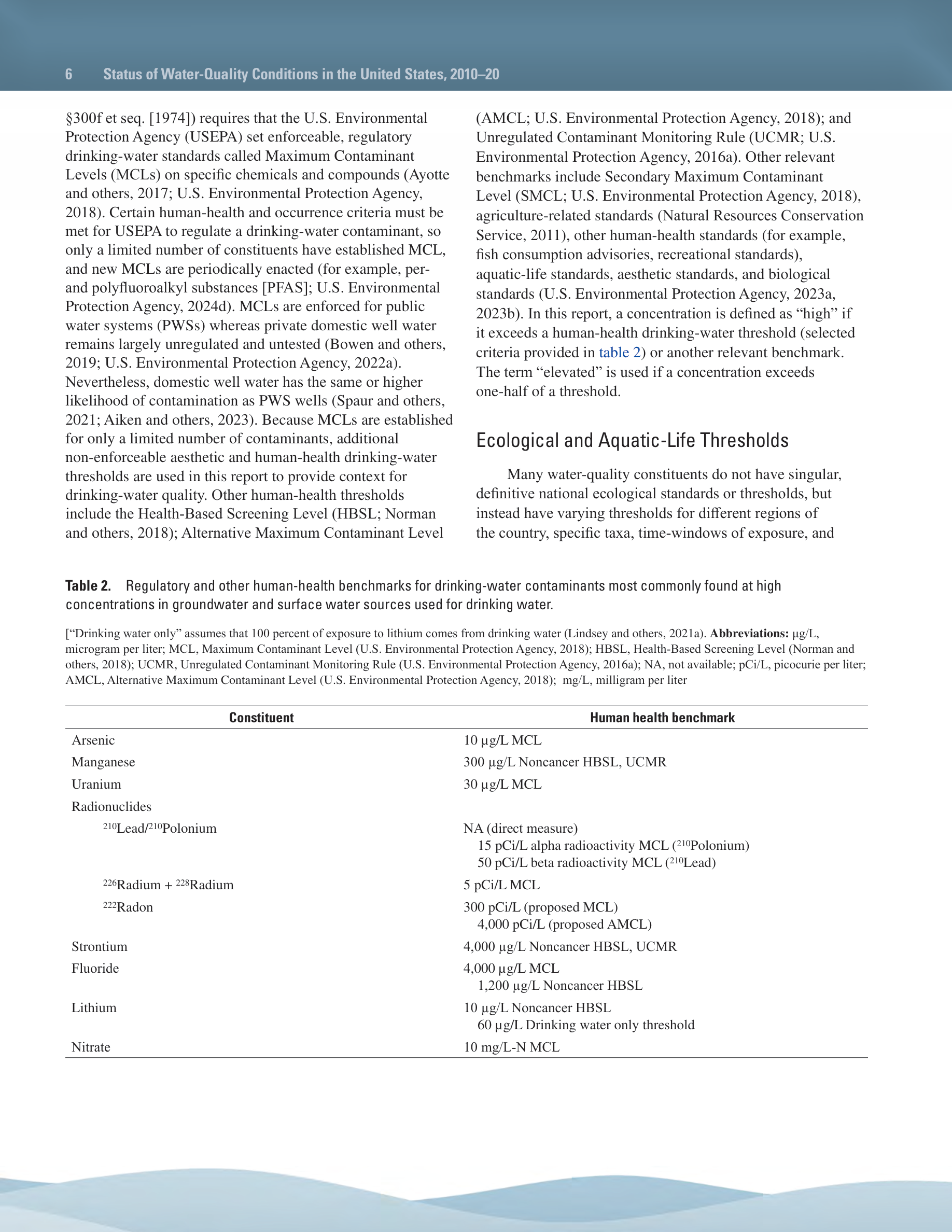
P1 · Left text column
A text region keeps a column together instead of interleaving it with the column beside it.
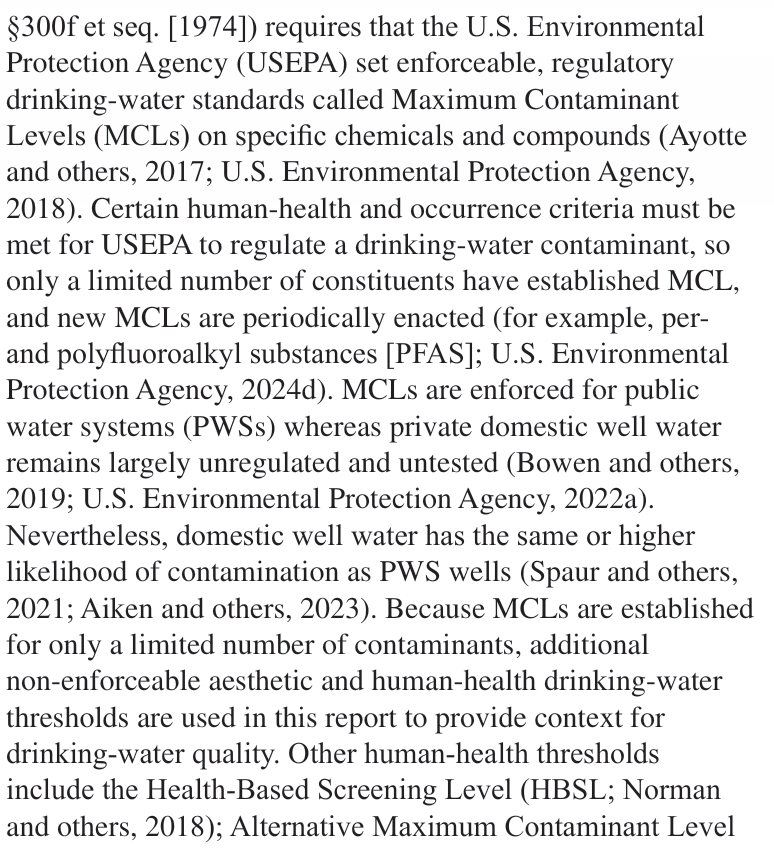 Open crop at full size
Source PDF: Status of Water-Quality Conditions in the United States, 2010–20 · printed page 6 (PDF page 18).
U.S. Geological Survey, Professional Paper 1894–C, version 1.1 (2025). Boundaries drawn manually for this explanation; not model predictions.
These are practical problems for applications built on extracted documents. Search needs passages with coherent boundaries. A financial workflow needs to distinguish a total from a nearby subtotal. An assistant answering questions about a paper needs the qualifications in a caption as well as the values in a chart. A clean-looking transcription can conceal a structural error until someone relies on it.
The same issue becomes more difficult across a long document. A report may start as a digital PDF, contain several scanned appendices, and end with photographs of signed forms. Processing every page in the same way is convenient, but it does not necessarily match the material. Stratify is intended to preserve enough information about each page and region to make a more deliberate choice possible.
How Stratify would process a document
The workflow starts with the source page and ends with a document someone can inspect. Each part has a concrete purpose. A provider may already cover several of them in one request, so these are not four mandatory model calls.
- Find the regionsLocate the text, tables, captions, and other parts of each page.
- Choose the readersUse the selected engines for each region, retaining useful provider output.
- Extract the contentRead the prepared crops with enough context to preserve their meaning.
- Reassemble the documentRestore reading order and relationships, with links back to the source.
Find the regions. Inspect the document’s pages, orientation, image quality, and usable embedded text. Locate the paragraphs, columns, tables, captions, and other regions, retaining their positions and relationships. That gives the rest of the workflow a map of what needs to be read.
Choose the readers. Use the customer’s configured engines for the identified regions. A customer might pair a layout detector with a vision model, or keep an existing provider’s paragraph extraction and choose a different reader for the tables. The processing plan needs to make those choices and their limits explicit.
Extract the content. Prepare each selected reader’s input at a suitable resolution, including neighboring context where it matters. Run the recognition step, retain useful existing extraction, and record which source region and engine each result came from.
Reassemble the document. Restore reading order, reconcile overlapping crops, and reconnect headings, captions, notes, and tables. Deliver usable text or structured data with source references and visible gaps where processing is incomplete.
If a provider already returns a useful table with cell relationships and page coordinates, Stratify should retain that work. Repeating a successful extraction adds cost without a clear purpose. The development documentation describes the proposed behavior and integration boundaries in more detail.
Reading in pieces without losing the whole
In the annotated USGS page, P1 and P2 identify the main text columns. H1 is a heading, P3 its paragraph, C1 the table caption, N1 the explanatory notes, and T1 the table itself. These are editorial identifiers for this example. In a working pipeline, a layout detector would supply region locations and likely types, giving later steps a stable way to refer to each part.
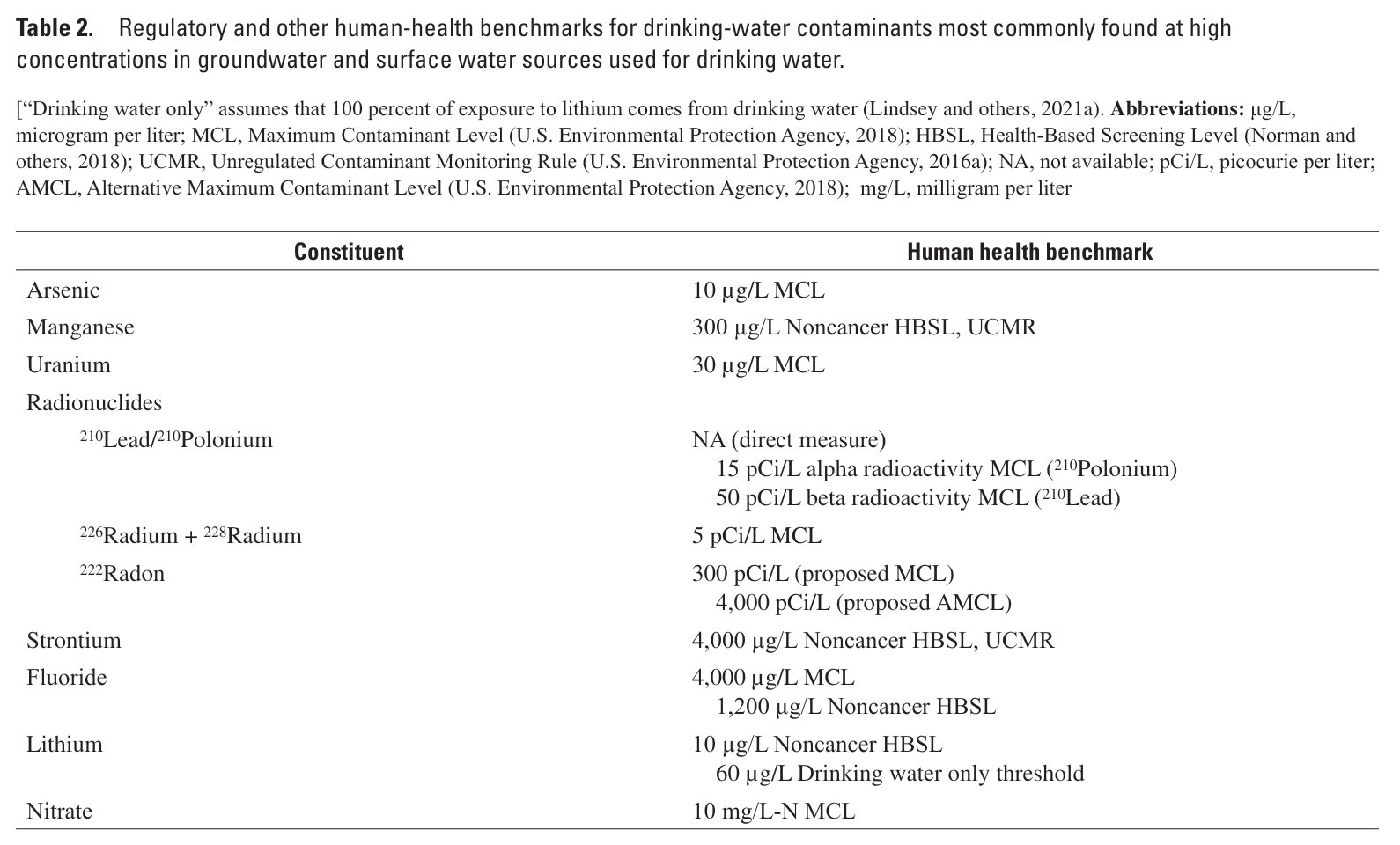
The same source pixels, with different crop boundaries. Open at full size.
Preparing T1 requires a decision about context. Its column headers and cells fit inside one rectangle, but the definitions of MCL, HBSL, and other abbreviations sit above it in N1. The caption in C1 explains what the table describes. Including all three regions gives a reader more context without sending the entire page. Toggle the example above to compare both crops; the underlying document pixels stay unchanged.
The system also needs to know how a crop relates to the original. Rendering can change resolution; pages can be rotated; providers can report positions using different coordinate systems. A result associated only with the final crop image is not enough for a user who wants to highlight the corresponding area of the original PDF. That transformation needs to remain traceable.
Overlapping crops create another assembly problem. Including surrounding text can help a reader interpret a table, but that text should not appear twice in the final document. Context sent to a model and content selected for output are related, distinct decisions. The region representation needs to preserve that distinction.
Some failures cannot be fixed by preparing a different input. Enlarging a poor scan does not restore a missing digit. A page cut off at the edge of a photograph may remain incomplete. In those cases, the useful result is an honest indication of uncertainty and a link to the source, rather than a confidently completed value.
Combining a segmenter with an OCR or vision model
A segmenter answers a question about layout: where are the parts, and what roles do they appear to have? A recognition engine answers a question about their content. Some providers handle both. Others offer a dedicated layout detector or a model that is particularly useful for a certain kind of input.
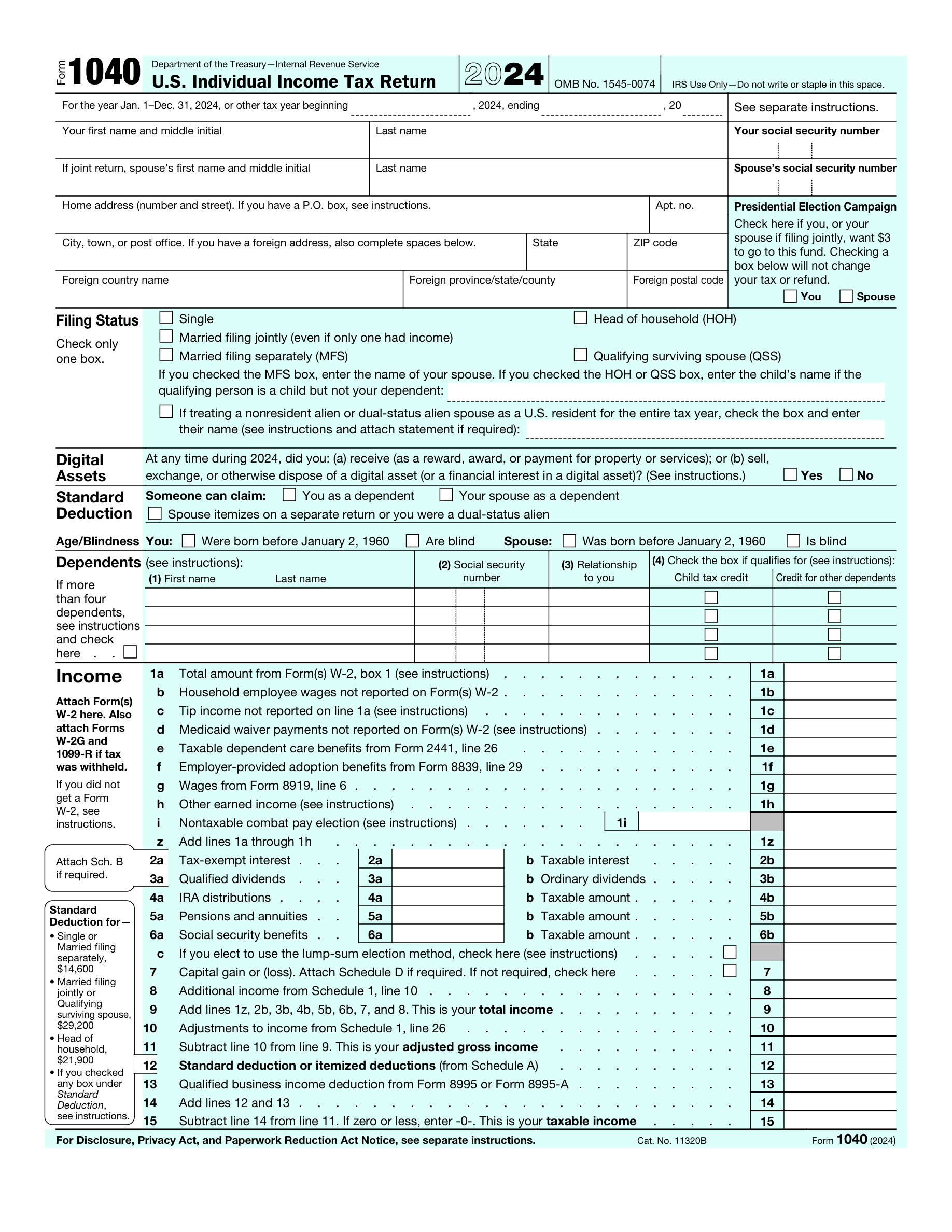
Stratify would support explicit combinations. A customer could select one detector and one recognition model for all regions, or keep a provider’s paragraph extraction and send selected tables or annotations to another reader. The blank IRS form below shows why the input matters: address fields, checkbox choices, a dependents table, and numbered income rows are different structures on the same page.
F1 · Names and address fields
Field labels and their blank entry areas form a different structure from paragraphs.
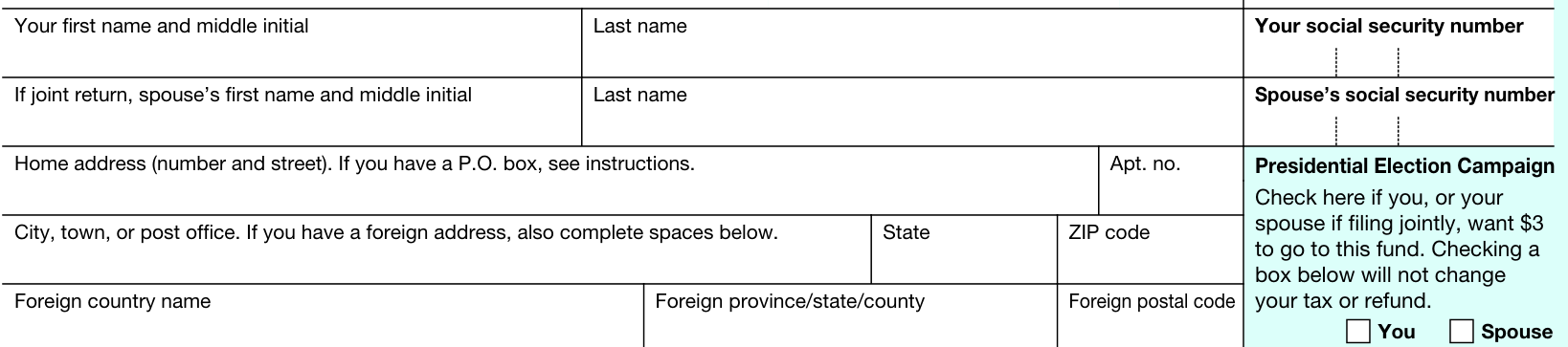 Open crop at full size
Source PDF: 2024 Form 1040 · printed page 1.
Internal Revenue Service · blank published form. Boundaries drawn manually for this explanation; not model predictions.
A table reader might preserve the dependents column headings and entry cells together. A form reader would need to retain the relationship between a checkbox and its label. A text reader could handle the margin instructions separately. This form is blank; a faithful result would preserve empty fields rather than inventing values. Asking an LLM to explain a form is a different operation from transcribing its contents, and the workflow should make that distinction explicit.
The coordination is the part we want OpenOCR to supply: preparing the inputs, sending each to the configured engine, recording what completed, and keeping the results connected to their source regions. A customer should not have to build a separate cropping and reconstruction service just to test a segmenter with a preferred reader.
This does not assume that specialized combinations will always win. A document model that receives the whole page may understand context that a crop leaves out. A general vision model may already read a particular table accurately. We need to evaluate the actual combination on representative inputs, including the work required to prepare and assemble them.
Returning a document you can inspect
The results need to come back as a document, not an unordered collection of model responses. In the USGS example, P1 precedes P2, H1 belongs with P3, and the table retains links to its caption and abbreviation notes. The identifiers carry through so a user can compare any part of the extraction with the original page.
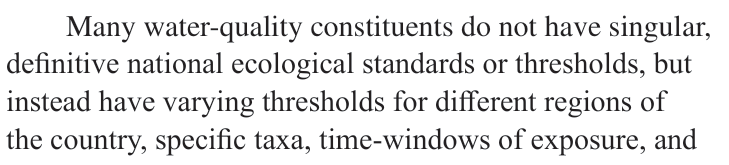
A selective retryIf the table needs another pass, replace T1 while preserving the accepted paragraphs and their page references.
Many water-quality constituents do not have singular, definitive national ecological standards or thresholds, but instead have varying thresholds for different regions of the country, specific taxa, time-windows of exposure, and
PDF bounds: 304, 296, 547, 351 points
That representation is also the foundation for selective retries. Suppose the paragraphs are acceptable but a table cell is wrong. A user could select T1, choose another engine, and request another pass. Its replacement would need to be reconciled with the accepted document while leaving the accepted paragraphs, caption, and notes in place. A retry should not silently rewrite unrelated content.
Keeping a history of that decision would help explain the result. Which engine produced the first version? What input did the second engine receive? Did the replacement include a different crop or more context? These are useful questions when comparing alternatives, investigating an error, or deciding whether a new result is trustworthy enough for the next step.
A failed region should also remain visible. If a provider times out while reading T1, the system may still have usable paragraph results. Returning those as a complete document would hide the missing work. The planned result needs per-region completion information so the application can distinguish a partial extraction from a finished one and decide whether to retry or ask for review.
The exact response schema is still being designed. What matters at this stage is preserving the information required for these behaviors. Flattening everything into a single text string too early would make selective replacement and inspection much harder to introduce later.
Building on provider capabilities
OpenOCR already supports provider-native PDF processing for compatible engines and page rendering for engines that accept images. Some providers also return their own layout or document analysis. Stratify would extend those foundations with a shared representation for regions and relationships across engines.
There are useful capabilities to build on. Mistral OCR documents structured document output, including layout information. AWS Textract offers analysis of tables, forms, and layout. PaddleOCR provides a dedicated layout detector that is a candidate for pairing with a separate recognition model.
- Page and region references
- Text, cells, and relationships
- Origin of each result
These responses are not interchangeable without translation. A provider’s “block” may represent a line, a paragraph, or a table. Coordinates may be normalized or expressed in another unit. A table can carry cell positions, merged cells, and relationships that would disappear if we kept only its text. The common format needs to retain those distinctions.
That is why the first planned step is preserving useful provider structure. Before introducing another recognition pass, we need to establish what the existing result contains and whether it can support region selection and assembly. Supporting a provider in OpenOCR today should not be taken to mean that every advanced operation from that provider is already exposed.
Adapters will need to be checked against the relevant operation and model version. A list of text chunks is not the same thing as a set of regions with coordinates. The integration has to establish what can be traced to the page, what can be reused, and what would require another detector or recognition pass.
How we plan to evaluate it
A longer pipeline introduces more places for an error to occur. A detector can miss a footnote, a crop can remove a qualification, and assembly can duplicate a sentence. The evaluation needs to consider the document that comes out of the entire workflow, not just the accuracy of a model on isolated regions.
We plan to compare proposed Stratify combinations with individual providers on the same inputs. The set needs documents that expose different problems: multi-column papers, dense tables, small captions, mixed digital and scanned pages, equations, and annotations. A simple letter should also be represented, since extra processing needs to justify itself on ordinary documents as well as difficult ones.
Text accuracy is one measure. Reading order, missing content, duplicate regions, and table relationships matter too. For the USGS table, recognizing a value while attaching it to the wrong constituent is still an incorrect result. For the blank form, turning an empty checkbox into a selected answer would be another kind of failure. A score that overlooks those relationships would give an incomplete picture of whether the pipeline helped.
Elapsed time and total cost belong in the same evaluation. A crop may be small but still involve rendering, detection, another provider request, and reconstruction. A selective retry is useful only if it produces an acceptable result without repeating unnecessary work. The plan should also account for retries that fail, rather than reporting only the cost of a successful final call.
We have not published Stratify benchmark results, pricing, or claims of performance gains. Confidence information needs its own evaluation: scores returned by different providers may describe different things and cannot simply be averaged. Until those signals are understood, customer-selected processing and visible uncertainty are a more defensible starting point than automatic routing based on a single score.
From the API to the workbench
We expect Stratify to be optional. The intended API approach is a processing choice alongside the customer’s selected engines, with explicit control over layout and recognition. The contract has not been finalized, so there is no supported Stratify parameter to add to a request today. Existing requests should not acquire extra processing calls merely because this capability is introduced.
In the workbench, the useful controls would be tied to the document itself: inspect a detected region, see which engine read it, compare the extraction with the page, and request another pass where needed. Showing the detected boundaries would also let a user distinguish a segmentation problem from a recognition problem. A perfect transcription of the wrong crop still needs the crop to be fixed.
The intended progression is to preserve provider structure, support explicit engine combinations, and then introduce region inspection and retry controls. Automatic engine selection is a later possibility. It needs evidence about where a combination helps, what it costs, and how it fails before the system can make that choice responsibly on a customer’s behalf.
Provider visibility and cost limits are part of the proposed design. A customer should be able to understand which services receive the document or crops and which additional work is permitted. Changing the reader for one region should remain an understandable processing decision, not an unexplained chain of fallbacks.
What we want to learn from difficult documents
The first version needs a concrete set of problems to solve. A report that loses its column order is different from a scanned form with faint handwriting. A table continuing over three pages presents different questions from a one-page receipt. Describing those failures precisely will help us choose evaluation cases and decide which controls are worth building first.
If your documents lose their columns, captions, table relationships, or annotations during extraction, contact OpenOCR with a description of what goes wrong. The useful starting point is the behavior: what you expected to retain, what the extraction lost, and what you had to repair afterwards. There is no need to assume a particular model combination is the answer.
We will keep the Stratify development documentation aligned with the proposed workflow and integration boundaries as the work takes shape. Stratify remains in design and planning, with no announced release date. The goal is a practical extension of OpenOCR that gives customers more control over difficult documents and a clearer account of how their results were produced.
Document sources: USGS Professional Paper 1894–C, version 1.1 (February 2025), printed page 6; and the IRS 2024 Form 1040, page 1. The cover and crops reproduce the published documents. Region boundaries and relationships are manually annotated examples. The text excerpt uses the PDF’s embedded text layer. None of these examples is a Stratify detection, OCR result, or benchmark.