TrOCR: What Happens When You Throw Out OCR's Entire Playbook
Based on: TrOCR: Transformer-based Optical Character Recognition with Pre-trained Models — Minghao Li, Tengchao Lv, Jingye Chen, Lei Cui, Yijuan Lu, Dinei Florencio, Cha Zhang, Zhoujun Li, Furu Wei
Picture the OCR pipeline that shipped in nearly every production system before 2021. A CNN looks at the image and extracts visual features. An RNN reads those features left to right and guesses characters one at a time. Then, because the RNN's guesses are often garbage, a separate language model gets bolted on afterward to clean up the output, correcting "rn" into "m" and fixing the fifteen other ways a scanner mangles a receipt.
Three models, three training regimes, three sets of bugs. That's the setup TrOCR (Microsoft, 2021) throws out. Its pitch: use a Transformer for the image, use a Transformer for the text, pre-train both, and skip the separate language-model cleanup step entirely. No CNN. No RNN. No bolted-on spell-checker. And according to the paper, this simpler design beats the specialized, hand-tuned systems it replaces on printed, handwritten, and scene text.
That's the surprising part worth sitting with. OCR is one of those fields where decades of accumulated hacks usually beat clean architecture. TrOCR is a case where clean architecture won anyway.
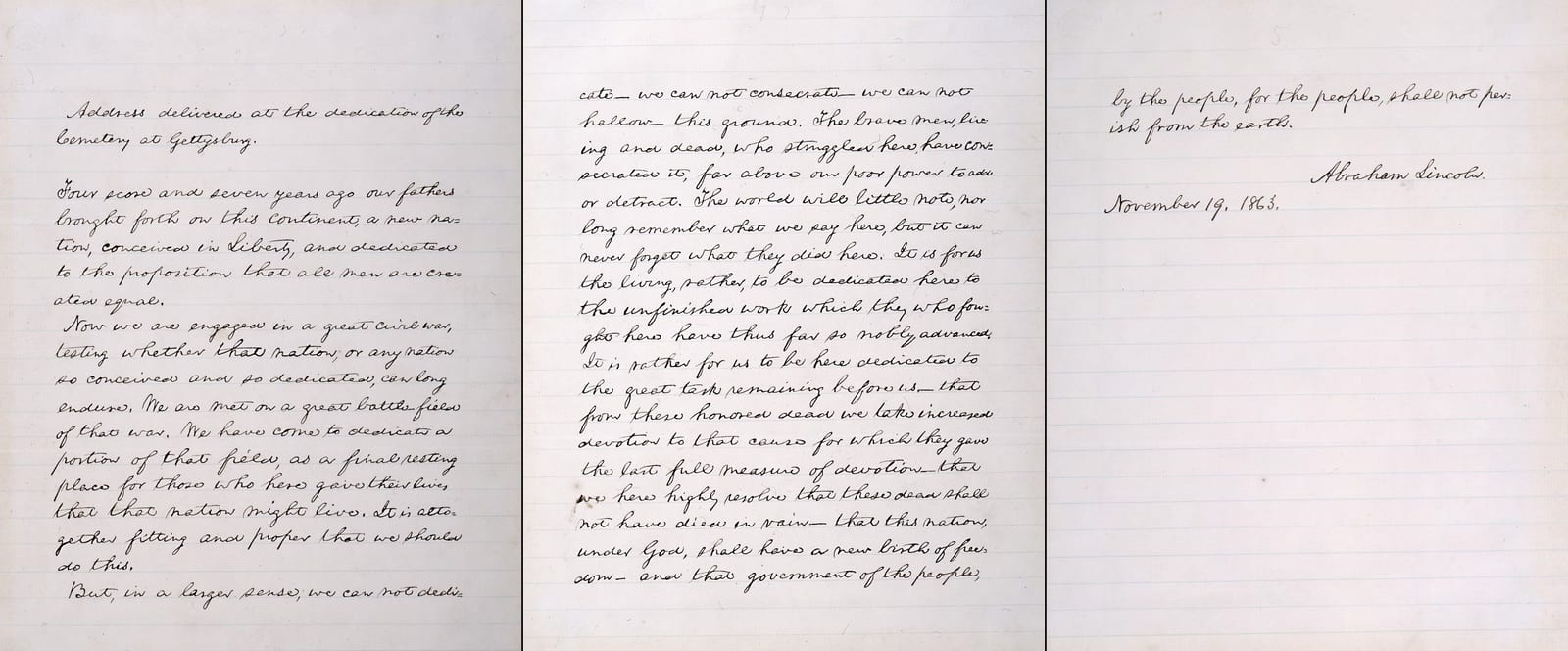
The Bliss copy of the Gettysburg Address, in Abraham Lincoln's hand (1864); public domain, via Wikimedia Commons.

Why OCR is a harder problem than it looks
If you've never built an OCR system, it's easy to assume the hard part is "read the letters." It isn't. The hard part is that image-to-text is really two problems stapled together, and they fail differently.
Problem one: understanding what's in the image. Fonts vary. Handwriting varies more, sometimes so much that two samples from the same person are barely related. Scanned receipts have creases, shadows, and coffee stains. Photos of street signs have weird angles and lighting.
Problem two: generating coherent text from those visual cues. A model can correctly identify every stroke of a word and still spit out nonsense, because recognizing shapes and producing valid sequences are different skills. This is why traditional pipelines added the language model in the first place. The vision component was good at "what does this look like" and bad at "what would a real word actually be here."
The traditional fix, RNNs for decoding plus a bolted-on language model, works, but it's fragile in a specific way: every fix targets one failure mode without touching the others. Blurry image quality is a vision problem. Awkward spelling and word-boundary issues are a language problem. You end up patching each piece separately, and the seams between the pieces become their own source of bugs.
The actual idea: two pre-trained Transformers, talking to each other
TrOCR's move is to notice that both halves of the problem, "understand an image" and "generate a plausible sequence," already have excellent pre-trained solutions sitting around, just not originally built to talk to each other.
For the image side, TrOCR uses a Vision Transformer (ViT-style) encoder, already pre-trained on large image datasets. Instead of a CNN sliding filters over pixels, a Transformer breaks the image into a grid of patches and lets each patch attend to every other patch. That matters for text specifically: a Transformer's attention can directly connect a character on the left edge of a word with one on the right edge, something CNNs approximate more painfully through stacked layers.
For the text side, TrOCR uses a Transformer decoder, pre-trained the way large language models are: predict the next piece of text given what came before. Crucially, it doesn't generate character by character. It generates in wordpieces (subword chunks, the same tokenization scheme used by BERT and GPT-style models). That's a meaningful design choice: predicting "ing" as one token instead of "i", "n", "g" as three separate guesses lets the model lean on the same kind of language knowledge that makes modern text generation fluent, instead of relying on a bolted-on spell-checker downstream.
Both halves start from models pre-trained on their native domains (images, text) and then get fine-tuned together on the actual OCR task. That two-stage recipe, pre-train separately, fine-tune jointly, is the paper's real contribution. The architecture (Transformer encoder feeding a Transformer decoder) isn't new. Using it to unify image understanding and text generation into one differentiable model that shares no separate language-model stage is.
Practically, this means the traditional third stage, the post-hoc language model, disappears. Language knowledge doesn't get bolted on after the fact; it's baked into the decoder from pre-training, and it gets fine-tuned jointly with the vision half instead of operating as an independent patch.
The training trick that makes it work: fake data first, real data second
Transformers are notoriously data-hungry, and labeled OCR data (a human sitting there transcribing exactly what a scanned image says) is expensive to produce at scale. TrOCR sidesteps this with synthetic pre-training: generate millions of images of rendered text using varied fonts, backgrounds, and distortions, where the "label" is just whatever text was used to render the image. No humans needed, because you already know the ground truth; you made it.
The numbers here are the tell. TrOCR pre-trains on hundreds of millions of these synthetic text-line images before ever touching a human-labeled dataset. Only after that does it fine-tune on the much smaller, real, human-labeled benchmarks (things like SROIE for receipts, IAM for handwriting). This is the same pattern that made large language models work in the first place: cheap, abundant, synthetic-ish pre-training, followed by a small dose of expensive, high-quality fine-tuning data. TrOCR is applying that recipe to vision-to-text instead of text-to-text.
What they actually found
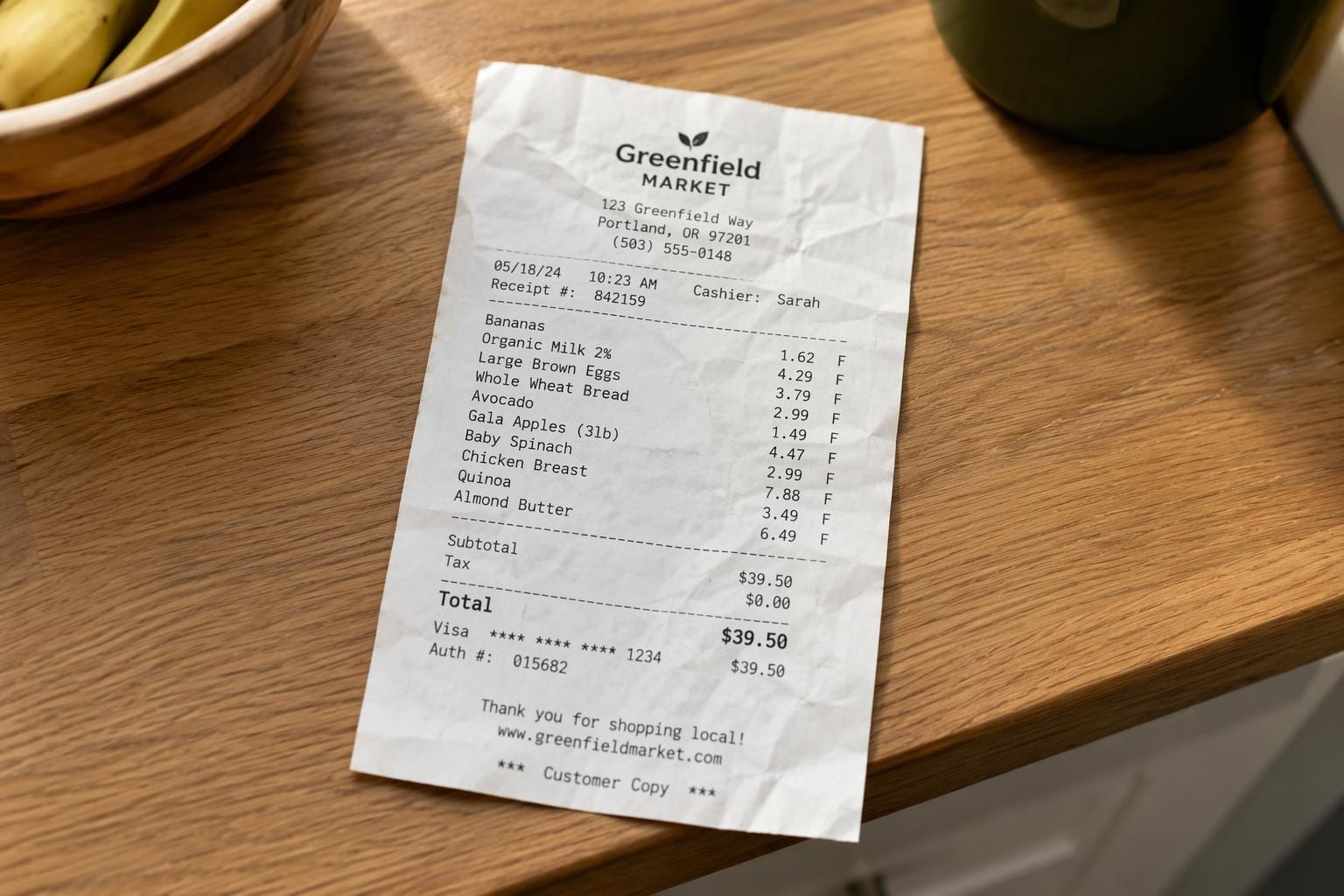
On printed text (the SROIE receipt-recognition task), TrOCR-large hits 96.4% F1, beating the best prior system on that leaderboard. Receipts are a genuinely nasty test case: variable layouts, faded thermal printing, and inconsistent fonts across different stores' POS systems. Beating a specialized system here, one likely tuned specifically for receipt quirks, with a general architecture is a real result, not a marginal one.
On handwriting (the IAM dataset, a long-standing benchmark built from scanned handwritten forms), TrOCR posts a character error rate around 2.89%, again ahead of prior state-of-the-art approaches that were purpose-built CNN-RNN-language-model stacks. Handwriting is the harder of the two problems in most people's intuition, since letterforms vary so much between writers, so a general Transformer architecture holding up here is the stronger of the two results.
On scene text (photos of text in the wild, like storefront signs or product packaging shot at an angle, on the ICDAR and other benchmarks), TrOCR also comes out ahead of the comparison systems the paper reports. Scene text is typically OCR's most brutal category: perspective distortion, occlusion, and inconsistent lighting all stack on top of the usual recognition problem.
Across all three categories, printed, handwritten, and scene text, the same architecture wins without task-specific redesign. That consistency matters more than any single number. Prior state-of-the-art systems tended to be specialized per category; TrOCR is one recipe applied three times.
Where it gets weaker, and why this isn't magic
The paper's numbers are for line-level recognition. TrOCR reads a line of text you've already located and cropped; it doesn't find that line on a page for you. In a real production system, something else, a separate detection step, still needs to figure out where the text regions are before TrOCR ever sees them. That "where is the text" problem (called text detection or layout analysis) is a whole separate research area, and TrOCR doesn't touch it.
The synthetic pre-training data, while large, is still synthetic. Rendered fonts on rendered backgrounds don't perfectly capture the mess of a real scanned document: torn corners, staple holes, water damage, a photocopier's toner streaks. The fine-tuning stage on real labeled data is what closes that gap, but it means TrOCR's ceiling on any specific document type still depends on how well-matched the fine-tuning data is to that document type.
And model size is doing real work here. TrOCR-large is a big model, and the paper's strongest numbers come from the large variant, not the base or small ones. The gap between TrOCR-small and TrOCR-large is meaningful, which means the deployability of "TrOCR" depends heavily on which size you're actually running, and how much latency and compute budget you have.
Why it matters for anyone building or buying OCR
If you're evaluating OCR engines today, TrOCR is worth understanding for a specific reason: it's a strong signal for where the whole field moved after 2021. Most modern OCR and document-AI models, including many that show up in engine catalogs and benchmark comparisons now, descend from this same idea: pre-trained vision Transformer feeding a pre-trained text Transformer, fine-tuned end to end, no bolted-on language model. When you see a newer model boasting Transformer-based architecture instead of CNN-RNN, TrOCR is very likely part of the lineage that got the field there.
Practically, this shift changed what "hard" cases look like. Older CNN-RNN-plus-language-model pipelines struggled most with anything the language model couldn't predict its way around: unusual proper nouns, part numbers, mixed-language documents, anything where the "correct" text isn't a plausible dictionary word. Transformer-based approaches like TrOCR still aren't perfect on these, no model is, but the failure mode shifts. Since the language understanding is baked into pre-training rather than patched on afterward, these models tend to be more consistent across document types instead of excelling on clean printed text while falling apart on messier handwriting or scene photos.
For anyone comparing OCR engines in practice: don't just check accuracy on clean printed documents, since that's the easy case nearly everything handles well now. Check performance specifically on handwriting, receipts, and scene text, the categories TrOCR's paper singles out as historically hardest, because that's where the architectural choices underneath a given engine actually show up in the numbers.